|
Getting your Trinity Audio player ready...
|
RICHMOND, VA — A full-scale emotional catastrophe erupted across Democratic political circles this week after the Virginia Supreme Court committed what party insiders are calling “an act of unimaginable extremism” by suggesting that sorting voters primarily by race may not be the healthiest foundation for constitutional democracy.
The ruling reportedly triggered immediate panic among elite consultants who had spent years perfecting congressional districts shaped like injured sea creatures fleeing a grease fire.
“This is devastating,” sobbed one exhausted strategist while dragging census blocks across a laptop screen like a deranged Sims player. “If courts are suddenly against race-based map drawing, then what’s next? Equal treatment under the law? Geographic continuity? Human sacrifice? Where does it end?”
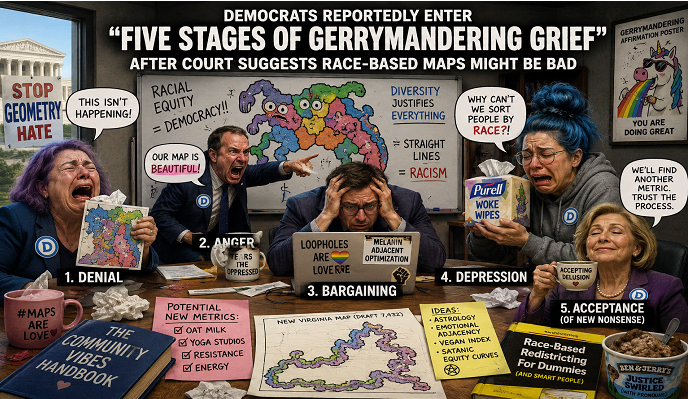
Witnesses say the Democratic establishment quickly entered the now-famous “Five Stages of Gerrymandering Grief”:
1. Denial
“At no point were we using race to draw districts,” insisted one consultant standing beside a district map that looped through six counties, crossed two rivers, and briefly entered Maryland “for equity reasons.”
Another strategist argued the district only appeared racially engineered because “justice itself naturally forms the shape of a caffeinated squid.”
2. Anger
Within hours, MSNBC launched emergency coverage titled Democracy Under Siege: Why Straight Lines Are Fascism.
Panelists took turns accusing the court of “weaponizing geometry” while touchscreen maps flashed behind them like nuclear launch coordinates.
One commentator became visibly emotional after accidentally zooming out far enough for viewers to realize a proposed district resembled a ruptured intestine wrapped around Interstate 95.
“This isn’t just an attack on voting rights,” she warned. “This is an attack on the sacred progressive tradition of pretending racial sorting is different when we do it.”
3. Bargaining
Sources inside Democratic strategy meetings say consultants immediately began searching for loopholes.
“What if we don’t call it race?” asked one operative. “What if we call it ‘melanin-adjacent community optimization’?”
Another reportedly proposed districts based on “historically marginalized vibes,” while a third suggested replacing elections entirely with rotating activist councils selected through NPR pledge drives.
One emergency Zoom call allegedly lasted eight hours after a junior staffer accidentally suggested candidates should simply try persuading voters directly.
“That kind of dangerous radicalism has no place in modern politics,” replied a senior adviser.
4. Depression
The mood reportedly darkened after several consultants experienced what psychologists call “sudden cartographic clarity,” a terrifying condition in which district maps begin looking normal.
One strategist stared silently at a compact district for nearly twenty minutes before whispering:
“My God… everyone in it actually lives near each other.”
He was later transported to a recovery facility where specialists are slowly reintroducing him to oddly shaped districts using exposure therapy and old Elbridge Gerry sketches.
More Read

Meanwhile, activists gathered outside the courthouse holding candles and signs reading:
⦁ “MAPS ARE VIOLENCE”
⦁ “RECTANGLES ENABLE OPPRESSION”
⦁ “STOP THE COUNT(Y LINES)”
⦁ “COMPACT DISTRICTS ERASE LIVED EXPERIENCE”
⦁ “GEOMETRY IS A TOOL OF COLONIALISM”
One protest organizer reportedly burst into tears after accidentally unfolding a map of Wyoming.
5. Acceptance
By week’s end, party leaders had reportedly accepted that future maps may need to comply with constitutional standards rather than progressive fan fiction.
Still, several consultants remain hopeful.
“We’re adapting,” said one veteran operative while unveiling a new district connected entirely by bike paths, emotionally supportive coffee shops, and one extremely long pedestrian bridge. “This map is completely race-neutral. We only used vegan co-op density and oat milk purchasing trends.”
More Read

Political scientists say the controversy ultimately reveals a deeper philosophical divide within modern politics.
“One side thinks race-based decision-making is inherently wrong,” explained a constitutional scholar. “The other side thinks it’s wrong unless accompanied by the correct yard sign and a land acknowledgment.”
Social media reactions remained predictably calm and reasonable.
One viral post declared the ruling “literally worse than climate change,” while another claimed requiring race-neutral districting was “an assault on historically underrepresented map enthusiasts.”
A third user simply posted:
“If race can’t determine district boundaries, how will politicians know which voters to paternalistically rescue?”
At press time, Democratic strategists were reportedly exploring several replacement methods for future redistricting efforts, including astrology-based representation, emotional support districts, community chakra mapping, and one proposal to divide Virginia entirely according to kombucha consumption patterns.
Early test maps have already produced a district stretching from Richmond to Portland, Oregon “in solidarity.”